Summer Writing Update

Heading into this summer, I only set the following writing goals:

  1. Make my poetry manuscript as publication-ready as possible
  2. Complete a first draft of a book-length memoir
  3. Write a blog post every other week here on plainswriter.com
  4. Finish a revision of a short story

Poetry Manuscript:

This project is “done” (for the moment), and it’s a wonderful and exciting and satisfying feeling. The proposal and “final” manuscript have been sent to my publisher for to begin the various processes on their end. At this point I can’t elaborate more on the publishing component, but I will share more information in the future, and I will be using this website to promote the book, which is called Your Twenty-First Century Prayer Life: Poems.

Memoir:

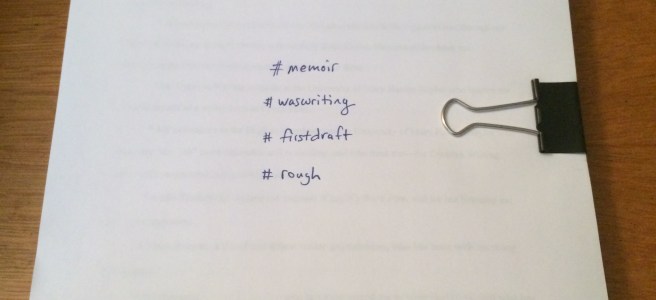
As of yesterday morning, I finished the first draft of the manuscript. It’s rough, as would be expected, and because it covers several decades of my life, and sketches out various scenes, I had found increasingly difficult to add “new” content.

My first drafts of any kind of prose writing tend to be more skeletal, and so I decided it was time to call the first draft “done” and print it out. I already have some ideas about how and where I need to develop nascent ideas and places that I probably need to delete.

When I printed out all those pages late yesterday morning, that was a rewarding feeling. I am also excited about beginning the revision process because for me, revision is what I enjoy most about the writing process.

Blog Posts:

While 2016 was my “year of blogging,” this year I moved away from writing for others, for the most part. Part of me feels a little guilty about it, which is, of course, bizarre and illogical. Over the summer, I focused on the poetry manuscript and the memoir first draft, my two “big” projects.

Nonetheless, I wanted to get back into blogging in a less stressful, more freeing-way. I have enjoyed writing a post here on plains writer.com every other week. That rhythm feels about right to me, and plan to continue that schedule into the foreseeable future.

Short Story Revision:

Periodically throughout this summer I’ve returned to a short story that I’m revising for a second draft. For reasons I’m not entirely sure of, I’ve found it difficult to gain traction on the story to finish a second draft. However, I’d like to make my way through it before the summer ends, and I believe that’s a reasonable goal.

Just this morning I returned to the story and found that I had “fresher” eyes to see the story. After working on the two big projects, revising a story feels so much more manageable.
Poetry Surplus

In addition to working on the first draft of a book-length memoir, I’m working on a book-length poetry manuscript. The latter is much further along in the writing process. Roughly a quarter of the poems have been published in various journals and magazines, and I’ve been revising the poems for several years.

I’ve been working on revisions with the help of an editor/poet as well as with another poet. The poems are, overall, becoming more precise and sharp. I’m starting to see the manuscript as a more coherent whole, observing previously unnoticed connections between poems. There’s a satisfaction in those “discoveries.” Right now, I’m revising the last ten poems before I send them along to the editor.

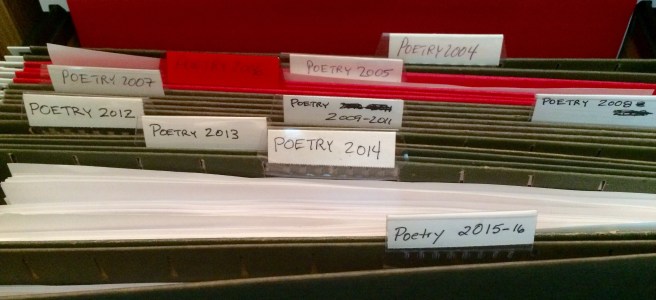
While this experience has been rewarding in so many ways, it motivated me to examine my unpublished poems that are not a part of this manuscript. A few years ago, I sorted through folders of unpublished poems, tallying some 300 (a conservative estimate). To be clear about the status of these unpublished poems, some are first drafts, second drafts, or third drafts.

I have begun pondering how to tackle those poems remaining in my hanging file folders (and their electronic counterparts) dating back to 2004. How could I possibly get a handle on these poems? How could I even begin the process of sorting through them?

However, because of my attention on this manuscript, I’ve been thinking of poems as groups, as possibly other books or poetry chapbooks. Last Monday, for instance, I flipped through the poems in each folder, beginning with the most current. As I worked my way backwards in time, I spotted poems that still had potential.

In that post I mentioned earlier, I resolved to work on revising those older poems. Since then I have only been working on the poems in the manuscript. Yet working on this manuscript has inspired me to continue revision, and without the responsibility of summer teaching, I have the mental space to work on tackling the stacks of unpublished poems.

As one way to get a handle on these poems, I decided to start a notebook listing the poems by year, a way that I can make use of one of my many notebooks. Furthermore, I can investigate the possibilities of other manuscripts in what I already have sitting in those hanging file folders. I feel an excitement about my poetry that I haven’t felt for quite some time.

Working Alone and Together

It’s stating the obvious to observe that writing is a solitary pursuit, but there, I’ve gone and said it anyway. No one will write my poems for me, my stories for me, my essays for me, or even that book-length memoir for me. No one. I am the one who chooses (or not) to work on these pieces, even this piece.

I’m by myself at this moment (5:45 a.m.), the rest of my family still sleeping.  A glass of cold water and a cup of coffee both within reach, a candle burning, a solitary lamp lighting me as I work. No one ordered me to set my alarm for 5:30.

To be clear, I am mostly comfortable with this arrangement of my writing life. It’s no real bother to be “by myself” trying to put down the right word, then the next right word, etc. (I’m not sure how strong extroverts manage to become writers, but they do.)

But the other day I was thinking about my “condition,” 12 years removed from finishing my MFA, 5 years removed from finishing my PhD. I realized an essential component of the writing life I was missing: accountability with another writer.

To me, one of the best benefits of the graduate Creative Writing courses I took was the accountability built into the system. I had to turn in a story every few weeks. I had to turn in a poem each week. Beyond those structural “checks,” fellow writers and I talked in and out of class about our writing. There was genuine community, and I made friends with many of these folks, people I still keep in touch with to this day.

My writer-friends are scattered around the country: Oklahoma, Illinois, South Dakota, Minnesota, Kansas, Iowa, Georgia, among other states. I see these folks at conferences, at retreats. I see them online.

What did I do about this lack of accountability?

I reached out to one of my writer friends, to someone I thought who knows my “work,” what I’m “trying to do.” Would he like to start swapping work? He said yes, and we’re in the very first stage of this process, more accurately, on the first piece we sent each other.

As I write this, I am rereading the poem he sent, pining over what comments I might make. And in this set of actions, I’m moving beyond that inward focus towards the self. I am instead considering how I might encourage the writer, what words I might offer that can be of help.

It is a tiny step, yes, towards focusing outward, toward others. Of course, I am curious about what comments he’ll make on my poem. Right now, however, I am not considering that. I am (re)learning this truth: we were made for community.