Poetry Surplus

In addition to working on the first draft of a book-length memoir, I’m working on a book-length poetry manuscript. The latter is much further along in the writing process. Roughly a quarter of the poems have been published in various journals and magazines, and I’ve been revising the poems for several years.

I’ve been working on revisions with the help of an editor/poet as well as with another poet. The poems are, overall, becoming more precise and sharp. I’m starting to see the manuscript as a more coherent whole, observing previously unnoticed connections between poems. There’s a satisfaction in those “discoveries.” Right now, I’m revising the last ten poems before I send them along to the editor.

While this experience has been rewarding in so many ways, it motivated me to examine my unpublished poems that are not a part of this manuscript. A few years ago, I sorted through folders of unpublished poems, tallying some 300 (a conservative estimate). To be clear about the status of these unpublished poems, some are first drafts, second drafts, or third drafts.

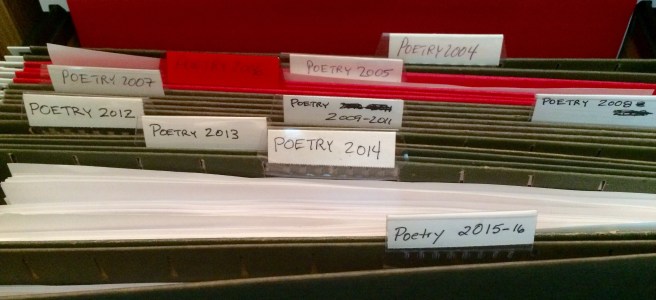
I have begun pondering how to tackle those poems remaining in my hanging file folders (and their electronic counterparts) dating back to 2004. How could I possibly get a handle on these poems? How could I even begin the process of sorting through them?

However, because of my attention on this manuscript, I’ve been thinking of poems as groups, as possibly other books or poetry chapbooks. Last Monday, for instance, I flipped through the poems in each folder, beginning with the most current. As I worked my way backwards in time, I spotted poems that still had potential.

In that post I mentioned earlier, I resolved to work on revising those older poems. Since then I have only been working on the poems in the manuscript. Yet working on this manuscript has inspired me to continue revision, and without the responsibility of summer teaching, I have the mental space to work on tackling the stacks of unpublished poems.

As one way to get a handle on these poems, I decided to start a notebook listing the poems by year, a way that I can make use of one of my many notebooks. Furthermore, I can investigate the possibilities of other manuscripts in what I already have sitting in those hanging file folders. I feel an excitement about my poetry that I haven’t felt for quite some time.
Memoir First Draft

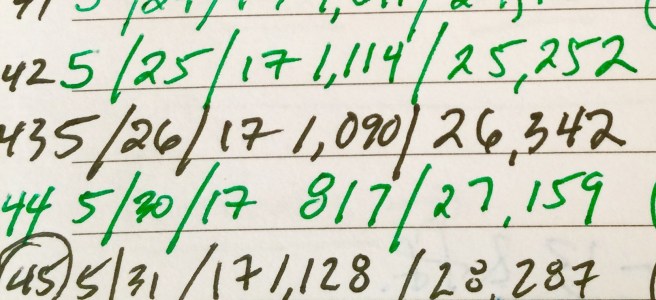
I’m currently writing the first draft of a book-length memoir. Since the first week of May, I’ve written over 12,000 words, reaching the 30k-word mark on Friday.

I’m a big believer in the quick first draft, a draft in which I do no editing, with the exception of fixing a typo. My approach works well for blog posts, short stories, creative nonfiction pieces, and poems.

The challenge right now, however, is sticking to the “pure drafting” approach while working on something book length—that’s more daunting. For example, in this draft I repeat myself occasionally. When you’re working on a book that covers almost the entirety of your life and your 40, that’s bound to happen.

Another challenge as I write more and more material is the overall structure of the manuscript, yet I’m enjoying the process of writing material without the pressure to organize it in the moment. So as is often the case when I work on nonfiction, as I write more material, I acquire more topic ideas. So in this draft, I create a new section with information enclosed in brackets for new ideas that surface in the drafting process.

My goal for 2017 is to complete a full first-draft (which is at least 50,000 words). I hope to finish this draft before I leave for vacation at the end of July. As of this point, I have nearly 2 full months remaining, so my goal feels both reasonable and achievable.

Once I finish the full first draft, I will go through and outline the draft in the notebook I’m using for the project. I’m not making any committed decisions at this point, but I envision an opening essay that serves as an overture, with the rest of the book built around topical essays with only a loose chronological order.

A friend of mine also recently began the first draft of memoir, and an in email he mentioned the idea of swapping our drafts in the near future. At first the thought terrified me–never have I written a first draft so rough (or so it seems to me). But the opportunity to share the work with a friend whose eye I trust is rather more motivation to continue with the process of drafting the manuscript and also revising that “overture” essay to send to him soon.

Now back to work.


The Importance of Staring

At the risk of appearing foolish, a writer sometimes needs to be able to just stand and gape at this or that thing—a sunset or an old shoe—in absolute and simple amazement.

Raymond Carver

Over the last weekend in April, I was presenting at a conference in New York, a place I had never visited. Because I flew into JFK and my hotel was located on West 71st, I rode over an hour in a taxi. The afternoon was overcast, with the temperature in the low 60s. I sat in the backseat, a small sliding window open to the spring air.

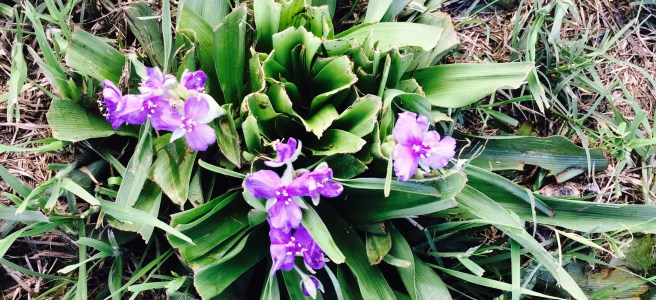
I stared out the window, gaping, taking in the details of the city: the branches beginning to bud, the beautiful lavender of a tree that looked familiar but I couldn’t name (Eastern Rosebud), the proximity of the houses to one another.

It struck me that I, for many years, did the same thing growing up whenever my parents were driving, whether it was around town, to a nearby town, or to the Minneapolis suburbs.

I love to drive (and that love manifests itself in much of what I write), but I was always happy to ride anywhere, and when I’m the passenger, I don’t have to consider traffic around me. I can let me mind wander, take in the sights.

In school, I occasionally was corrected by the teacher for staring out the window. I can still hear my junior-high English teacher telling me, “Nate, stop staring out the window.” To be clear, I liked English, a lot. But there were trees outside, birds flying by. Maybe a passing car. All of those things interested me, too.

Even my friends would make fun of me as I stared, open mouthed at somebody, at something—studying, wondering, questioning. “Catchin’ flies?” they would ask, and then laugh. It didn’t bother me that much—I’m sure I looked foolish.

Staring—the ability to actively take in my surroundings, to be curious about them, to study them—has been fundamental training for me as a writer. It is a disposition that is probably partly innate and a habit of mind that I have developed. I am often content to watch and ponder my surroundings, whatever is taking place.

Perhaps there’s a building I’ve seen a hundred times before, but this time I notice the way some of the letters in the sign are more faded than others. Perhaps it’s a road I’ve driven many times before, but this time I’m struck by a stand of pines, and notice how they extend further back from the road than what I recall. And when I visit someplace new, as I did NYC last month, my senses are overloaded with details, and I am reminded of how I have never struggled with boredom.